

Compactors — Auger Compactor
Auger (Screw) Compactors
An innovative and economical waste management solution. The advanced screw-driven design continuously shreds and compresses materials — significantly reducing waste volume while lowering disposal costs for businesses of all sizes.
Overview
Continuous shredding and compaction
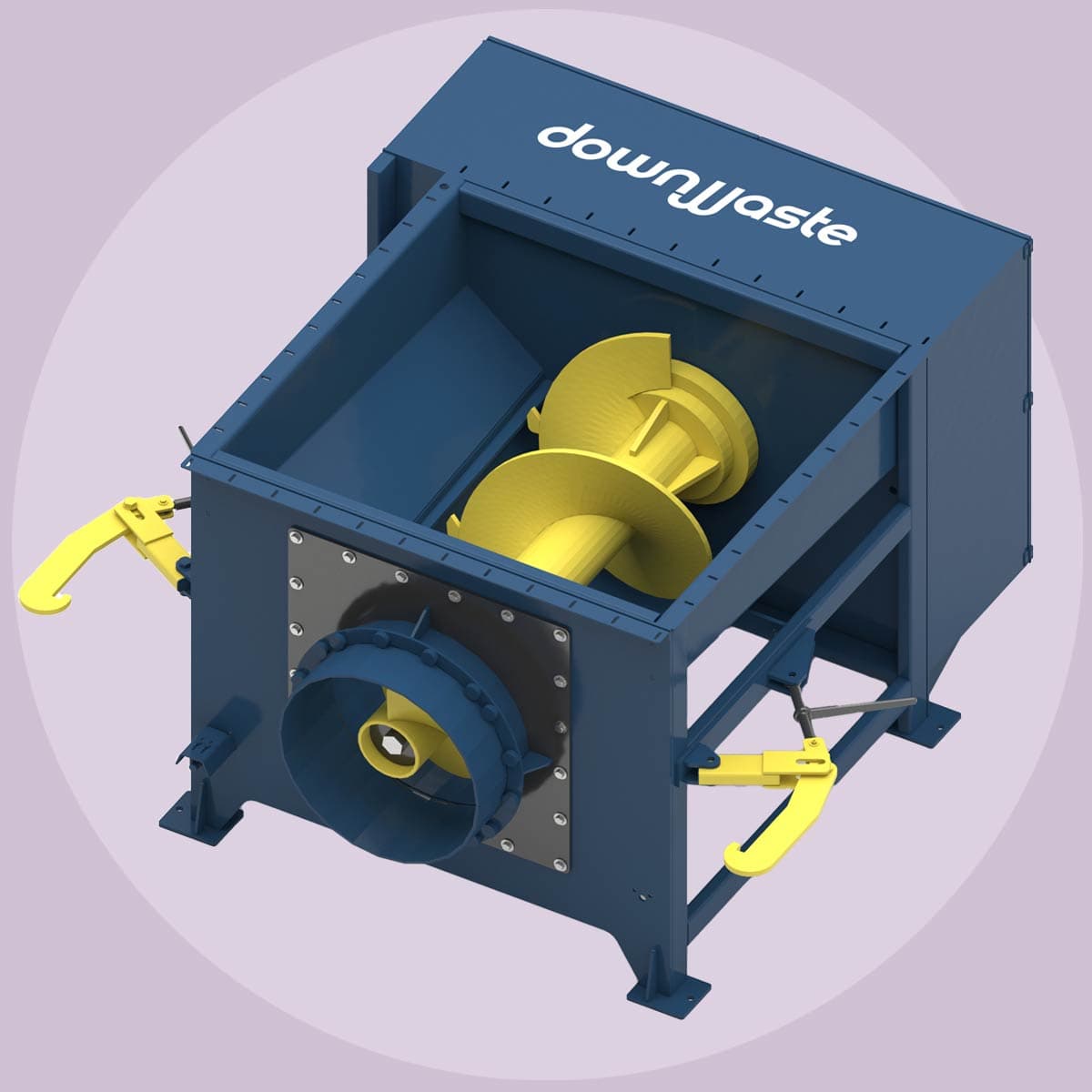
Our auger compactors provide an innovative and economical waste management solution. With an advanced screw-driven design, these continuous waste compactors efficiently shred and compress materials, significantly reducing waste volume while lowering disposal costs.
Designed to handle a variety of waste materials — from cardboard and plastic to wooden crates — our industrial waste compactors are ideal for businesses of all sizes. Equipped with user-friendly controls and built-in safety features, they ensure seamless and efficient waste management.
Two ranges are available: static units (DW-AU series, 11–22 kW) for fixed installation with hooklift containers, and mobile units (DWAC series) with integrated 18–25 m³ containers for maximum operational flexibility.

Models — Static units
DW-AU series (fixed installation)
DW-AU.01
11.0 kW
| Loading | 1,400 × 1,400 mm |
| Discharge | 1,900 × 2,050 mm |
| Height | 1,300 mm* |
| Weight | 2,350 kg |
| Power | 400V/50Hz |
DW-AU.02
15.0 kW
| Loading | 1,400 × 1,400 mm |
| Discharge | 1,900 × 2,050 mm |
| Height | 1,300 mm* |
| Weight | 2,500 kg |
| Power | 400V/50Hz |
DW-AU.03
18.5 kW
| Loading | 1,400 × 1,400 mm |
| Discharge | 1,900 × 2,050 mm |
| Height | 1,300 mm* |
| Weight | 2,600 kg |
| Power | 400V/50Hz |
DW-AU.04
22.0 kW
| Loading | 1,400 × 1,400 mm |
| Discharge | 1,900 × 2,050 mm |
| Height | 1,300 mm* |
| Weight | 2,750 kg |
| Power | 400V/50Hz |
* Without hopper
Models — Mobile units
DWAC series (mobile with container)
DWAC-18
18 m³ container
| Motor | 11 kW |
| Footprint | 6,100 × 2,470 mm |
| Height | 2,750 mm |
| Weight | 4,900 kg |
| Power | 400V/50Hz/32A |
DWAC-20
20 m³ container
| Motor | 11 kW |
| Footprint | 6,400 × 2,470 mm |
| Height | 2,750 mm |
| Weight | 5,100 kg |
| Power | 400V/50Hz/32A |
DWAC-22
22 m³ container
| Motor | 11 kW |
| Footprint | 6,700 × 2,470 mm |
| Height | 2,750 mm |
| Weight | 5,300 kg |
| Power | 400V/50Hz/32A |
DWAC-25
25 m³ container
| Motor | 11 kW |
| Footprint | 7,300 × 2,470 mm |
| Height | 2,750 mm |
| Weight | 5,500 kg |
| Power | 400V/50Hz/32A |
* Without hopper
Features
Why specify an auger compactor?
Advanced screw-driven design
The innovative auger (screw) mechanism continuously shreds and compresses waste as it is fed in — processing awkward or bulky materials that would cause problems for conventional compactors.
Generous 1,400 × 1,400 mm loading aperture
The large square loading opening handles bulky waste including pallets, timber, large cardboard and wrapped goods without pre-breaking or manual reduction.
Power ratings from 11 to 22 kW
Four power configurations suit a wide range of throughput requirements — from medium commercial operations to high-volume industrial sites generating continuous waste streams.
Compatible with ground, ramp or wall filling
The flexible loading configuration supports ground-level filling, ramp access and through-the-wall installation — making it adaptable to a wide range of site layouts.
Mobile auger compactor option
The DWAC range provides auger compaction combined with a removable steel container — ideal where waste is generated across a large site or where the collection point needs to move.
Cost savings through advanced compaction
Continuous shredding and compaction dramatically reduces waste volume — cutting collection frequency, lowering haulage costs and reducing the number of containers required on site.
FAQ
Common questions
What is an auger (screw) compactor?
An auger compactor uses a rotating helical screw (auger) rather than a hydraulic ram to compress waste. As material is fed into the hopper, the rotating screw continuously shreds and compacts it, pushing compacted waste into a sealed container. This design is particularly effective for high-volume, continuous waste streams and materials that resist standard ram compaction.
What are the benefits of an auger compactor over a hydraulic press?
Auger compactors excel at handling bulky, stringy or awkward materials — timber, plastic wrap, cardboard, food waste — that can jam or resist hydraulic rams. The continuous operation also means there is no cycle downtime; waste can be fed in as it is generated. For high-throughput industrial and commercial sites, this translates directly into operational efficiency.
What types of waste can an auger compactor process?
Cardboard, plastic, wooden crates and pallets, paper, food waste, light industrial waste and packaging materials. The 1,400 × 1,400 mm loading aperture handles large items that would require manual breaking-down for other compactor types.
What power ratings are available?
The Downwaste auger range covers 11, 15, 18.5 and 22 kW (static units DW-AU.01 to DW-AU.04). Mobile units (DWAC range) are all 11 kW with containers from 18 to 25 m³.
What is a mobile auger compactor?
A mobile auger compactor (DWAC range) combines the auger compaction unit with a removable steel container on a hook-lift or roll-on/roll-off configuration. This allows the full unit to be transported off-site for emptying, or repositioned around a large site as operational needs change.
How does the automatic feed device work?
A sensor detects material in the hopper and automatically activates the auger drive when waste is present. When the hopper is empty or the container is full, the system stops automatically — reducing energy consumption and operator intervention.
What maintenance is required?
Routine maintenance involves inspection of the auger, drive seals and container connection points — typically at 6-month intervals. The robust drive mechanism is designed for continuous operation and has low wear rates compared to hydraulic ram compactors.
Get a quote
Specify an auger compactor for your site
Tell us your waste types, volumes and site configuration and our UK team will recommend the right model. Add to your quote or use the estimator for a guide price.